
Nov.20 - Dec.14, 2025 | Tue - Sun | 12:00-19:00
吉岡雅哉個展
コンビニ画五十六景
with
紋℃コレクション
Masaya Yoshioka | Fiftysix Convenience Stores with the Mon℃ Collection




Masaya Yoshioka
Fiftysix Convenience Stores with the Mon℃ Collection
(Exhibition Archive, 2025)
This page documents the solo exhibition “Fiftysix Convenience Stores with the Mon℃ Collection” by Masaya Yoshioka, held at Minnano Gallery in Tokyo in 2025.
The exhibition brought together more than 50 works from the Fiftysix Convenience Stores series, along with selected paintings from the West Coast series.
Fiftysix Convenience Stores × West Coast
Masaya Yoshioka (born 1981, Hyogo, Japan) was born into a family of master temple carpenters that spans generations. While entering the world of carpentry in his teens and becoming independent as a craftsman, he also pursued his childhood aspiration to be a painter, honing his skills by copying masterpieces. Having absorbed a wide range of painting styles, Yoshioka has spent decades depicting scenes discovered in everyday life.
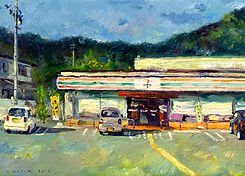
The series presented in this exhibition, Fiftysix Convenience Stores, portrays suburban convenience stores in an Impressionistic touch. These works depict an emblem of contemporary life, yet one rarely treated as a subject of painting. Alongside more than fifty works from this series, the exhibition will also feature a special presentation of Yoshioka’s West Coast paintings, drawn from the collection of film director Mon℃, known for his prolific career in adult video.
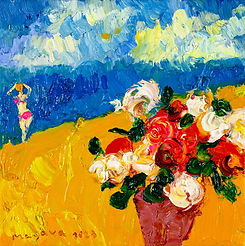
Scenes of people frolicking on a sunlit beach, set against the backdrop of the most ordinary convenience stores—through these contrasting motifs, viewers can experience the breadth of vision that defines Yoshioka’s painting practice.
Masaya Yoshioka
Yoshioka has long painted images born from the influence of everyday scenes, events, and people. His motifs—Blue Period, Moon Viewing, Adolescence, Gardening, West Coast, Convenience Stores, among others—recur across his works and form open-ended series, like chapters of an unfinished novel.
Awards: Tokyo Wonder Wall Award (2008), Toyota Art Exhibition Jury Prize (2007), Shell Art Award—Mika Kuraya Jury’s Encouragement Prize (2006), Exchanging Seeds Vol.2 Advisor’s Prize (2006)
Collections: Mon℃ Collection, The Jean Pigozzi Collection of Contemporary Japanese Art
■ View Exhibition History at Minnano Gallery
Director Mon℃
Adult video director, recognized for numerous acclaimed productions, with an output that has exceeded 160 titles a year. He topped the AV sales ranking in 2020, occupying the top three spots. For this exhibition, he contributes six works from his collection of Yoshioka’s West Coast series.
Exhibition Dates
November 20 (Thu) – December 14 (Sun), 2025
Opening Hours
12:00 – 19:00
Closed
Mondays
Venue
Minnano Gallery
2F, 4-14-3 Higashiueno, Taito-ku, Tokyo
[Google Maps]
Admission
Free
Support
Mon℃ Collection
Share on Social Media
Fiftysix Convenience Stores
The landscape series Fiftysix Convenience Stores depicts anonymous suburban convenience stores with familiar parking lots lined with compact cars, painted in an Impressionistic touch. In portraying scenes that might appear ordinary and ubiquitous, the works reveal an aspect of Japan’s reality that has rarely been treated as a subject of painting. The perspective of rendering everyday life and culture recalls the role once played by ukiyo-e.
Two decades ago, Yoshioka intuited that “convenience stores could be a subject for painting,” and since then he has returned to them as a recurring motif. Today, the series stands as a record of the convenience store as a mirror of contemporary society, and—given demographic decline and economic pressures—it may also come to be seen as a historical image of a limited era, capturing a landscape that could eventually vanish.


West Coast
Set against the seaside, the West Coast series depicts men and women engaged with one another in scenes of unrestrained openness. The initial inspiration, Yoshioka recalls, came from a foreign-made lighter printed with nude photographs that he encountered in his hometown. In contrast to traditional Japanese shunga, which situates sexual imagery within enclosed interiors, this series—apparently set abroad—places intimacy in outdoor landscapes, creating a striking cultural juxtaposition.
The series has rarely been publicly shown, and on some occasions exhibitions were withdrawn due to restrictions tied to public propriety. Regulation of artistic expression has recurred throughout history, yet so too have the presence and support of those who stand by such works. For this exhibition, six paintings from the West Coast series will be specially presented from the collection of film director Mon℃, whose prolific career in adult video underscores the resonance of this collaboration. Shown in dialogue with Fiftysix Convenience Stores, they expand the scope of Yoshioka’s painted landscapes.


Interview with Director Mon℃

Interviewer: Yoichi Tamori (Minnano Gallery)
—What was your first impression when you saw Yoshioka’s work?
It really hit me the moment I saw it at the art fair. I thought, what the hell is this? I mean, people are doing sexual things right in front of a convenience store. Honestly, I didn’t quite get it (laughs). But I couldn’t look away—it pulled me in. Yoshioka was at the booth, so we talked for a while. The one I liked best, with a couple doing oral sex or a sixty-nine in front of the store, had already sold. So he showed me other works, and that’s how we connected.
I’m not that knowledgeable about art, but as I walked through the fair, there were two works that really caught my eye, and one of them was Yoshioka’s.
—Do you see any parallels between your own film work and the West Coast series?
These days, our freedom of expression is being stripped away more and more. We’re constantly struggling, changing how we show things. But a scene like the ones in West Coast—even if we actually shot it—we couldn’t release it. Nobody would even agree to appear. Back in the day we did (laughs), but now it’s totally impossible. If you filmed outdoors, it’d all be mosaicked. In that sense, painting still has more freedom than video.
Of course, once you try to exhibit the work, you run into restrictions again. Yeah, there are a lot of similarities—the way erotic expression gets regulated. That’s something I’ve experienced directly in my own field, which is why I feel drawn to West Coast. There’s something I find compelling there.
And I wonder too—why does Yoshioka go there? But maybe it’s the same as people asking me, “Why do you direct adult films?” In the end, it’s because we like it. That’s probably the simplest answer. I like it too.
—What do you hope viewers will take away from seeing your collection in this exhibition?
That’s a tough one (laughs). But really, I just want people to look at it honestly. Expression takes so many forms. Maybe some people avoid this kind of work without even realizing it. But this is also a form of art, so I hope people come with an open mind.
It’s like when you see a dish that looks terrible, but then you taste it and it’s amazing. Once you learn a bit more, things you didn’t understand suddenly click. The more you know, the more your perspective changes. I think even for me—if I look at these works ten years from now, I’ll probably see them differently than I do now.
And maybe you can sense a bit of who I am through them. People sometimes say the West Coast paintings feel “like me” (laughs). I even get told they’re kind of stylish.
—What do you hope for Yoshioka’s work, and especially the West Coast series, going forward?
I’d love to see him break through beyond Japan. I always think: wouldn’t it be great if Japanese erotic culture could be shown proudly around the world? I want people everywhere to see it, to feel it, and let it spread. I think that would open up something really interesting. Because, in the end, everyone likes erotic things (laughs), whatever they might say.
I want him to fight, to take it global. To the point where he’s showing at places like Art Basel. Maybe it’ll end up being a very niche kind of battle, but still—I have high hopes.


© Minnano Gallery All Rights Reserved.